





How to Choose Pool Mosaic Tiles for Steps, Shallow Areas and Spas: Slip Resistance & Safety Guide
Pool tile safety should be evaluated by location. A vertical pool wall, submerged floor, entry step, shallow play area, spa seat and surrounding wet walkway are different use zones and should not automatically receive the same surface specification.
This guide helps pool builders, contractors, architects, hotel and resort buyers, distributors and project owners understand how slip resistance, surface texture, chip size, test methods, visibility and intended pool zone should be considered when choosing pool mosaics.
Slip-resistance requirements vary by country, pool type and project specification. Do not select a pool tile only because it has a higher numerical rating. Confirm the applicable wet-area or wet-barefoot test method, required classification and intended installation zone with the architect, pool consultant, local regulations and the product test report.
Quick Answer: What Pool Tile Is Best for Steps and Wet Areas?
The best pool tile is the product that is tested and approved for the exact use zone. For steps, shallow wet areas and spa access zones, buyers should evaluate wet slip resistance, surface profile, visibility, chip size, grout joints, comfort and maintenance together.
A glossy product that works well on a vertical pool wall should not automatically be assumed suitable for every horizontal or walking surface. Likewise, an R11 or R12 result alone does not automatically prove suitability for a barefoot swimming-pool step.
What Is Slip Resistance for Pool Tiles?
Slip resistance describes how a walking surface performs under defined test conditions when a person or test device moves across it.
Swimming pool environments are complicated because surfaces may be:
- Dry or continuously wet
- Used barefoot or with footwear
- Horizontal, sloped or vertical
- Submerged or above the waterline
- Used for walking, sitting or swimming rather than circulation
For this reason, a slip-resistance result only makes sense when the test method and intended area match the actual project condition.
Pool Mosaic Safety Parameters Buyers Should Check
| Parameter | Buyer Question | Why It Matters |
|---|---|---|
| Intended zone | Wall, floor, step, spa, shallow area or deck? | Different zones have different safety requirements |
| Test method | Which slip-resistance test was used? | Different methods are not directly interchangeable |
| Wet / dry condition | Was the product evaluated under relevant wet conditions? | Pool walking surfaces are frequently wet |
| Barefoot / footwear | Does the test correspond to how users actually walk there? | Barefoot and footwear testing represent different conditions |
| Surface texture | Glossy, matte, textured or structured? | Influences grip, comfort and cleanability |
| Chip size | Small mosaic or larger tile? | Changes the number of grout joints and surface geometry |
| Grout joints | What is the joint width and grout finish? | Joints contribute to the overall mosaic walking surface |
| Visibility | Are step edges visually identifiable? | Contrast may improve recognition of level changes |
| Maintenance | Can the texture be kept clean? | Contamination can change practical slip performance |
Pool Zone Safety Selection Matrix
| Pool Zone | Main Concern | Buyer Focus |
|---|---|---|
| Vertical pool wall | Submerged suitability and appearance | Water resistance, color, installation system |
| Submerged pool floor | Specified surface performance | Project requirement, surface, wet-use test data |
| Entry steps | Slip risk and level-change visibility | Wet-barefoot performance, contrast and edge design |
| Shallow standing area | Barefoot walking and standing | Wet slip performance and comfort |
| Children's splash area | Frequent movement in wet conditions | Project-specific safety rating and easy maintenance |
| Spa seat | Comfort and curved surfaces | Chip scale, texture and body-contact comfort |
| Spa entry step | Wet barefoot entry and exit | Slip test, visibility and comfortable texture |
| Pool deck / surround | Wet pedestrian circulation | Dedicated deck/floor specification and local safety requirements |
R11 vs R12: Is a Higher R Rating Always Better for Pools?
No. A higher numerical R classification should not automatically be interpreted as “better for every pool area.”
R classifications are associated with ramp testing under footwear-related conditions. Pool environments frequently include wet barefoot use, so the test method specified for the actual pool zone is important.
Modern European specifications may reference EN 16165 methods for slip resistance. Project documents in different countries may also use other national test methods or classifications.
What Buyers Should Ask Instead of Only Asking “Is It R11 or R12?”
- Which test method was used?
- Was the test performed for footwear or barefoot conditions?
- Was the surface tested in wet conditions?
- Which product code and surface finish were tested?
- Does the project specification require a particular classification?
- Is the test report valid for the exact product being ordered?
Key point: use the project-required test method for the intended zone rather than comparing isolated rating numbers.
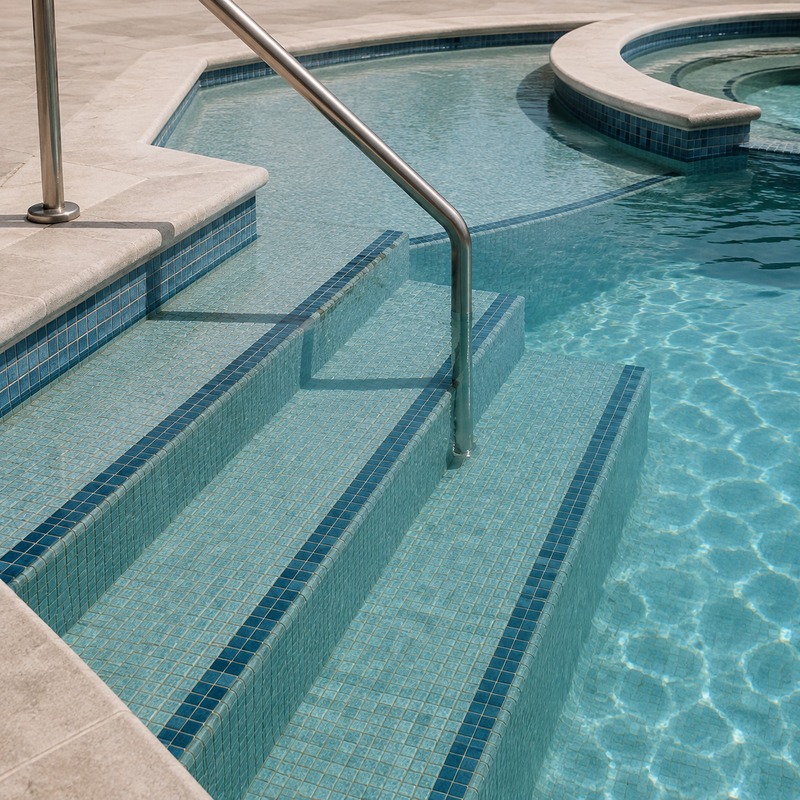
How to Choose Mosaic Tiles for Pool Steps
Pool steps combine two risks: a wet walking surface and a change in level.
Selection should consider:
- Wet-use slip performance required by the project
- Step geometry and tread dimensions
- Surface texture
- Chip size and joint density
- Visibility of tread edges
- Lighting conditions
- Ease of cleaning
Should Pool Step Edges Use a Contrasting Color?
Visual contrast can help identify a change in level, particularly in public or commercial pools. Whether contrasting strips, nosings or color changes are required should be determined by the project design and applicable regulations.
The contrast should be planned together with the overall pool mosaic design rather than added randomly after installation begins.
How to Choose Mosaic for Shallow and Children's Pool Areas
Shallow areas may involve more standing, walking and playing than deeper swimming zones.
Buyers should therefore pay particular attention to:
- The relevant wet-barefoot slip requirement
- Comfort under bare feet
- Drainage and slope design
- Visibility of depth changes
- Cleaning and maintenance
- Transitions into deeper areas
Do not select the surface purely by color or gloss level. Request technical data for the exact product.
How to Choose Mosaic for Spas and Wellness Areas
Spa environments combine curves, seats, steps, warm water, barefoot use and frequent body contact.
Suitable selection should balance:
- Surface safety
- Comfort
- Small-radius curve adaptation
- Water and chemical exposure
- Cleaning requirements
- Joint density
Smaller chips can be useful around curved spa seats and walls, but a smaller chip size alone does not prove slip resistance. The tested surface specification still matters.
Glass vs Porcelain Pool Mosaic for Safety-Critical Zones
Material category alone does not determine slip performance. Glass and porcelain products can both be manufactured with different surfaces.
| Factor | Glass Mosaic | Porcelain Mosaic / Tile |
|---|---|---|
| Visual effect | High reflection, color depth and decorative variation available | Matte, textured and architectural effects widely possible |
| Surface range | Glossy, iridescent, textured and other finishes | Glossy, matte, structured and textured finishes |
| Safety selection | Use product-specific test data | Use product-specific test data |
| Curves | Small glass chips can adapt well to curved surfaces | Small porcelain mosaic can also follow many curved areas |
The correct comparison is therefore not “glass versus porcelain” in general, but tested product A versus tested product B for a defined pool zone.
Do Small Mosaic Chips and Grout Joints Improve Grip?
Small mosaic installations contain more grout joints than large-format tiles. These joints change the texture and geometry of the finished surface and can influence how the surface feels underfoot.
However, buyers should not use joint density as a substitute for formal slip-resistance data when the project requires testing or a defined classification.
Maintenance Is Part of Slip Safety
Practical slip performance can be affected by contamination, scale, oils, biofilm, cleaning residues and worn surfaces.
The selected product should therefore balance surface grip with the ability to maintain the surface under the facility's real cleaning program.
Very aggressive texture is not automatically the best choice if the surface becomes difficult to maintain or uncomfortable for barefoot users.
What Should Buyers Request from a Pool Tile Supplier?
| Request | Reason |
|---|---|
| Exact product code | Ensures test data matches the ordered surface |
| Intended application | Confirms wall, floor, step or other use |
| Slip test method | Shows how the reported value was obtained |
| Test condition | Confirms wet/dry and barefoot/footwear relevance |
| Test report | Allows project team to verify result and product |
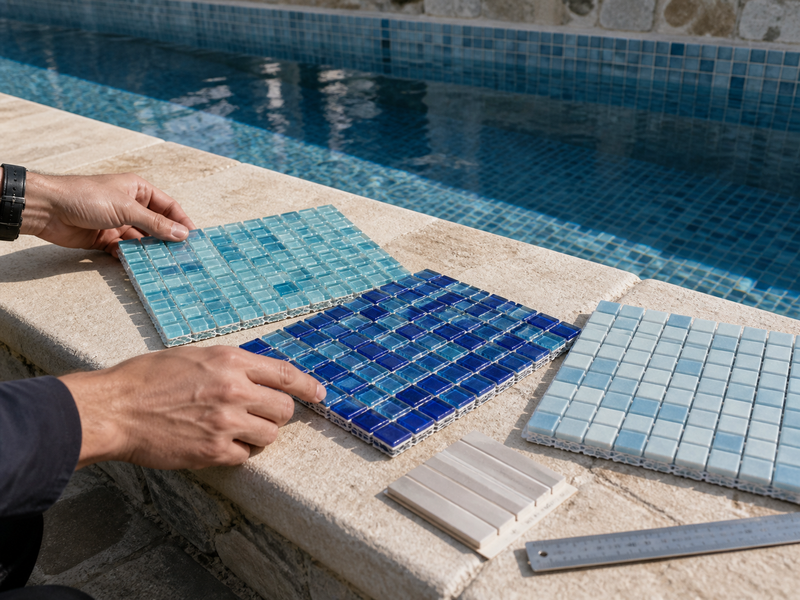
| Sample | Allows review of texture, color and comfort |
| Mounting specification | Supports correct pool installation |
Step-by-Step Safety Selection Process
- Identify the exact pool zone. Do not specify the entire facility as one generic “pool area.”
- Identify how people use the surface. Walking, standing, sitting, swimming, barefoot or with footwear.
- Review the project specification. Confirm required test method or classification.
- Shortlist products approved for that use.
- Request test data for the exact product and surface.
- Check texture and barefoot comfort using a physical sample.
- Review step visibility and color contrast where relevant.
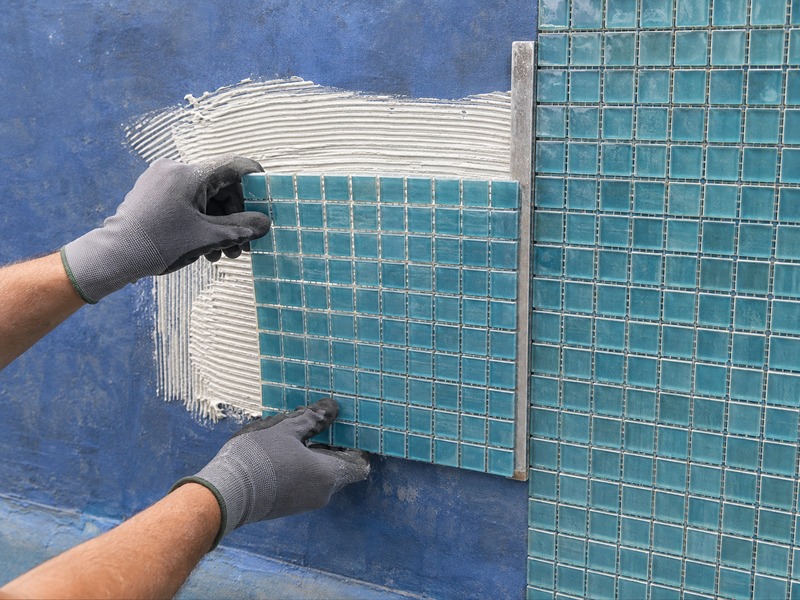
- Confirm installation and grout requirements.
- Confirm cleaning and maintenance requirements.
- Document the final approved specification before ordering.
Illustrative Case: Hotel Pool with Steps, Shallow Zone and Spa
This is an illustrative selection scenario rather than a named customer project.
Project Areas
- Main vertical pool walls
- Submerged floor
- Entry steps
- Shallow relaxation area
- Curved spa seats
- Spa entry steps
Selection Approach
- Use decorative pool-rated mosaic on vertical walls according to the visual design.
- Review floor products separately using the project's required surface-performance criteria.
- Specify pool steps using relevant wet-use slip data and consider visual contrast at changes of level.
- Check barefoot comfort and wet safety in the shallow standing zone.
- Use appropriately sized mosaic for the spa curves while still verifying the actual surface requirement.
- Do not rely on a general “R12” statement without confirming the test method and product code.
- Obtain physical samples and applicable reports before final approval.
Key lesson: one swimming pool may require several surface specifications because users interact differently with each zone.
Ralart Pool Mosaic Options for Different Project Zones
Ralart Mosaic offers glass and porcelain pool products in different colors, formats and surface directions. Final suitability for a safety-sensitive zone should always be confirmed using the exact product specification and applicable project requirements.
Frequently Asked Questions About Pool Tile Slip Resistance
1. Are glass mosaic tiles slippery?
Glass mosaics are available with different surface finishes. Do not judge slip performance only by material name; review test data for the exact product and intended pool zone.
2. Is porcelain better than glass for pool steps?
Not automatically. The correct choice depends on the tested surface, project requirement, chip format, installation and design rather than material category alone.
3. Is R12 better than R11 for swimming pool steps?
A higher R rating does not automatically mean better suitability for a barefoot pool step. Confirm whether the test method matches the intended wet barefoot condition and the project specification.
4. What does R11 mean for pool tiles?
R classifications are associated with a ramp-test approach for surfaces used with footwear. The rating should not be used alone to approve a barefoot pool zone.
5. What slip test should be used for barefoot swimming pool areas?
Use the method required by the project specification and local regulations. Current European projects may reference EN 16165 methods, while other markets may use different standards.
6. Should the same tile be used on pool walls and steps?
Not necessarily. A vertical wall and a walking step have different functional requirements and should be evaluated separately.
7. Are small mosaic chips safer than large tiles?
Small mosaics create more joints and a different surface geometry, but chip size alone does not prove required slip performance. Product-specific test data remains important.
8. What tile should be used in a shallow pool area?
Select a product suitable for the relevant wet barefoot use, considering slip performance, comfort, cleaning and local project requirements.
9. What mosaic should be used for spa steps?
Choose a product with suitable wet-use performance for the step, while also considering barefoot comfort, visibility, chip scale and installation around curved areas.
10. Does grout improve pool mosaic slip resistance?
Grout joints change the geometry and feel of a mosaic surface, but they should not replace formal slip-resistance testing where the project requires a defined result.
11. Should pool step edges use a contrasting tile?
Visual contrast can help users identify changes of level, but the requirement should be confirmed with the project designer and applicable local standards.
12. Can a glossy mosaic be used on a pool floor?
Do not approve or reject a product only from the word “glossy.” Check the actual intended-use recommendation and required test data for that pool zone.
13. Does maintenance affect slip safety?
Yes. Scale, contamination, oils, cleaning residues and surface wear can affect practical walking conditions, so maintenance should be considered during product selection.
14. What should I check on a pool tile slip-resistance test report?
Check the test method, exact product code, surface finish, test condition, reported result, laboratory information and whether the report matches the product being ordered.
15. What information should I send when asking Ralart for a safety-oriented pool tile recommendation?
Provide the pool zone, project type, destination market, required standard or test method, preferred material, color, quantity and any existing project specification.
Need Pool Mosaic Options for Steps, Spas or Shallow Areas?
Send us the project type, exact pool zone, preferred material, required test standard, quantity and destination market. Ralart Mosaic can help identify relevant glass or porcelain pool products and provide product-specific information for review.
Request Pool Tile Specification Support